The idea of pushing excellence in all facets of learning is something we explore during practice across all classes at the Tōukon Academy® – learning to become proficient and efficient is a core tenet.

One measure of excellence is simply your level of understanding on a given subject.

Creating, structuring and developing excellence is heightened when you have breadth and depth of knowledge on a given subject, with that increased level of comprehension there’s greater chance for refinement [across processes], which in turn shortens time associated with the acquisition of a skill and permits the removal of unnecessary layers in learning – including over-reliance on a coach.

Essentially you will become proficient and efficient faster if you learn to become your own coach and that’s where the Your Three Phase Practice Model comes in.
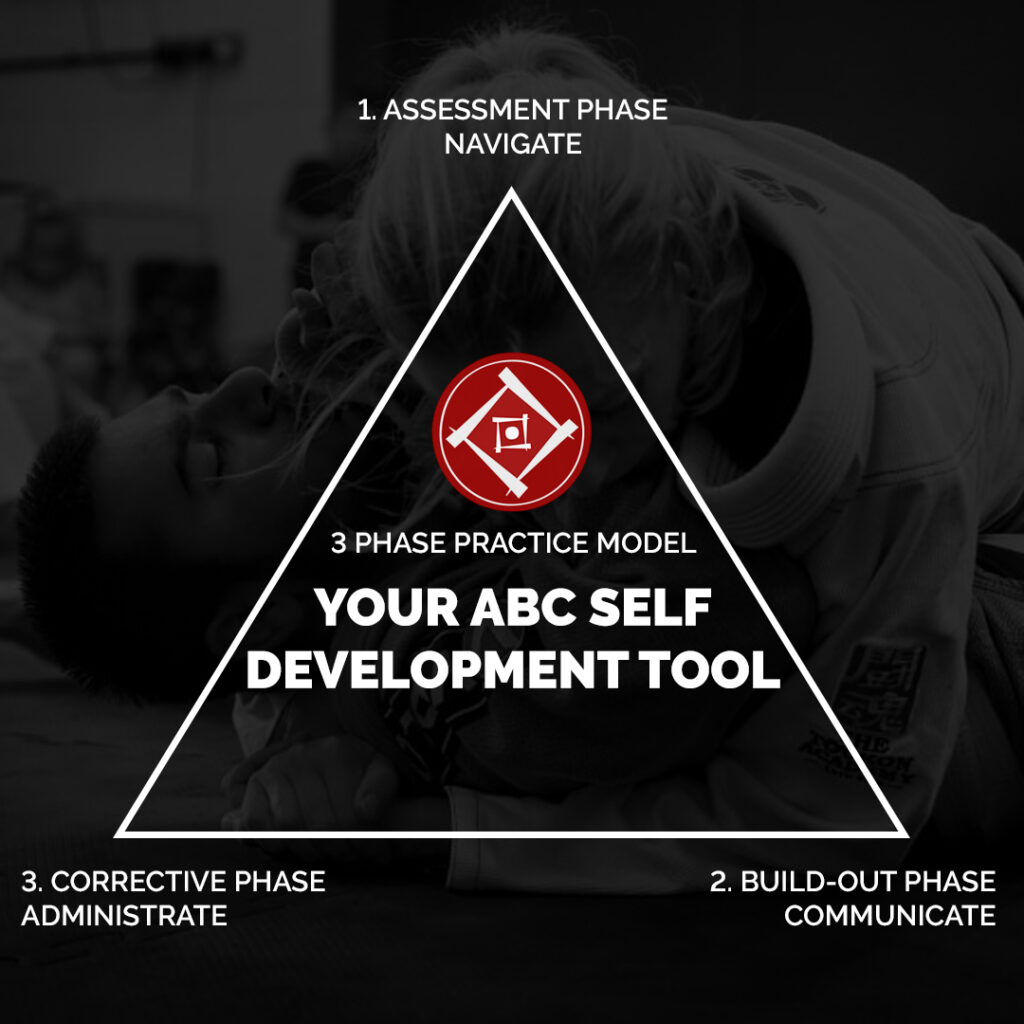
1. Assessment Phase (what to do)

The assessment phase is where your decisions originate.
Want to progress faster?
Then set a goal. Set a clearly defined path that has aim and a final objective.
To do this you’ll need to develop some persistence, be consistent and apply meaningful effort. If you don’t, progress will be slower, change more organic and not attributable. The attainment of a goal requires movements to be exact and precise. Intentions must be planned, thought through and carried out; there are methods and stages attached, victories and shortfalls can be measured and it’s the way you ultimately increase proficiency.
  • Where do you need improvement?
  • What area of your game is lacking?
  • Do you suffer recurring issues?
Understand what it is you are attempting to accomplish and begin to NAVIGATE your way, with ‘focused adaptability’, towards that end.

2. Build-Out Phase (how you do it)

Whilst navigating you way through to your goal, learn to communicate.
COMMUNICATE internally if you prefer or externally via commentary, learn to centre on a problem, pick through it logically and reinforce your solutions as a success.
Language and dialogue are critical, bring the focus from the assessment phase here; develop your cerebral understanding of mechanics, of consequence, of how things work. Self-talk should centre on the problem, and concentrate of solving with logic, deduction and reason. Rather than “I need to” re-frame: “if I do”, establish alternatives and substitutes: it’s physical dialectics.
This running internal or external dialogue will reinforce your navigation to the goal as well as teach you to acknowledge the correct logical way to move forward. In turn it informs your ability to recognise errors, instructing on how to overcome them and laying the foundations to foresee them.
Spend most of your time in the Build-Out phase, it’s where development occurs – development in breadth and depth of knowledge. Not only will your success grow but so will the appreciation of mistakes as it is those mistakes that are holding you back.

3. Corrective Phase (why you won or lost)

Learning to tidying up is important – corrective measures – understand why you succeeded or why you failed.
At an early stage you’ll tidy up in ‘debrief’, losing more often than winning. Nevertheless, with mat-time comes ability and the more you’ll tidy as you go, adopting a level of ‘feel’ and improved connection. As Matt Thornton ascribes: connection is a product of pressure, which is created through posture, all three fundamentally give rise to possibility.
Mat-time improves timing, which breeds anticipation, it also fosters comprehension of distance – the key ingredient to grappling skill.
A higher level of understanding will empower minor alterations and adjustments to be done at flow, reducing the need and regard for ‘hindsight philosophies’. Your objective is to learn at this phase, learn why you achieved your goal so you can repeat the success and learn what went wrong.
There is always something to do admin-wise, so ADMINISTRATE.
Perform those corrections that make you more proficient and efficient.